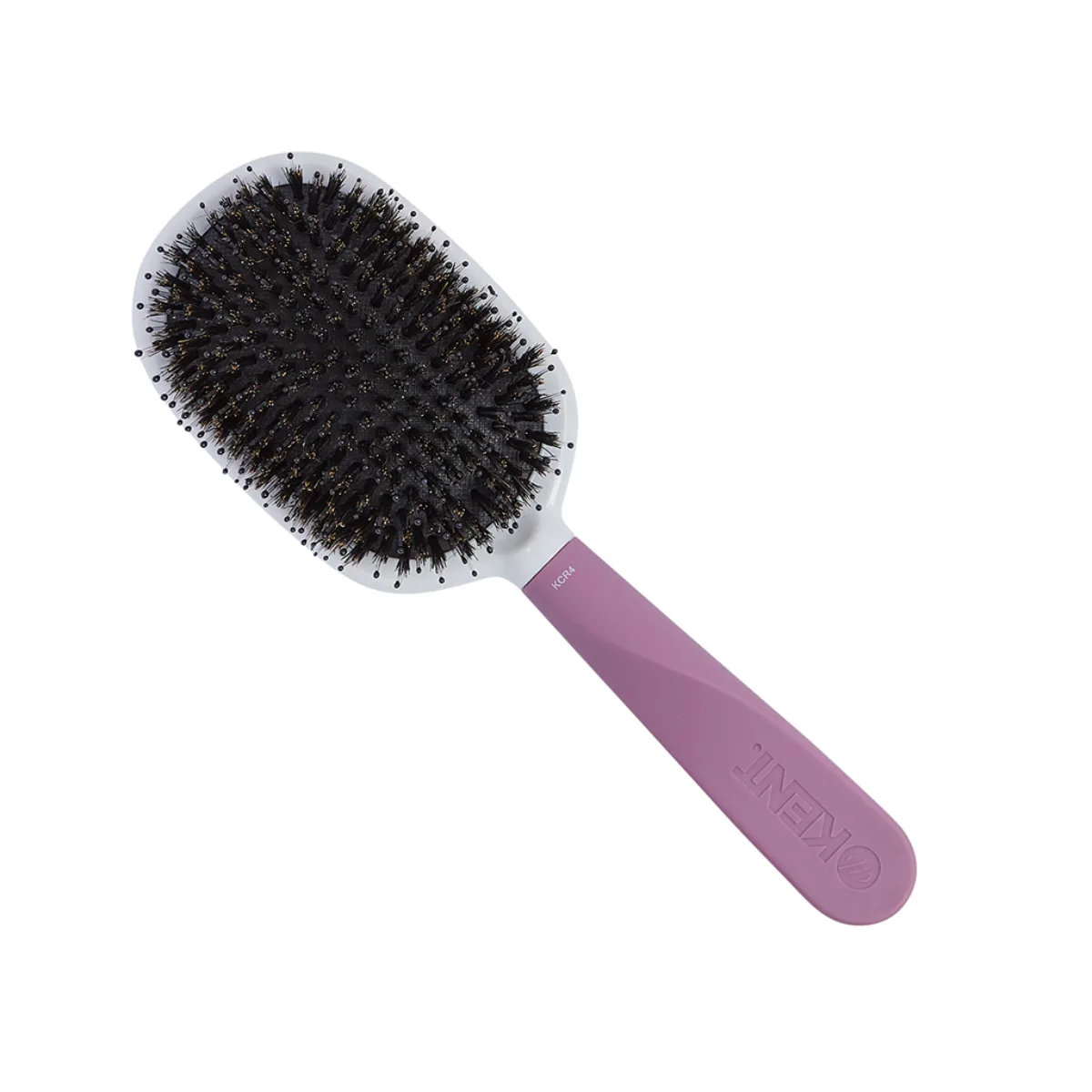
Most brushes on a pharmacy shelf look much the same, and most are bought on price. Yet the filling is the whole instrument. Boar bristle carries oil and coaxes out shine; nylon reaches deeper and undoes knots. Choose the wrong pairing for your hair and brushing becomes a chore that appears to accomplish nothing, or leaves finer hair crackling with static.
What pure boar bristle actually does
Boar bristle is keratin, the same protein as your own hair, and each bristle is finely scaled along its length. As the brush passes, those scales gather sebum at the scalp and carry it down the strand, and hair brushed this way daily acquires an even, understated lustre that no serum quite reproduces.
What a pure bristle brush offers above all is polish. It is at its best on fine to normal hair worn reasonably smooth, and it is comfortable company for the scalp. It will not reach through a thick head of curls, however; the bristles fold before the root, grooming the surface while the tangles beneath remain undisturbed.
Where nylon earns its place
Nylon quills are longer and stiffer than bristle, which is precisely their virtue. They reach the scalp through dense hair, ease knots apart, and lift the root under a blow-dry. The detail worth paying for is the tip: a properly finished quill is ball-tipped and glides over the scalp, whereas the cheap moulded sort is cut sharp and feels it.
Conditioning, though, is beyond it. Nylon has no scales, so it moves no oil, and a nylon-only brush is best regarded as a styling tool rather than a daily companion.
The mix: why most people should start here
A bristle-and-nylon mix sets longer nylon quills within tufts of bristle, so a single stroke does both jobs: the nylon opens the hair and clears the way, and the bristle follows to smooth and condition. For medium to thick hair it is the natural starting point, and the brush we most often find ourselves recommending first.
The general rule holds that finer hair calls for a greater share of bristle, and thicker or curlier hair for more nylon. Should you prefer not to weigh it up yourself, the short quiz below applies the same reasoning on your behalf.